Productivity Blueprint: Goals, Time Blocks, Routines
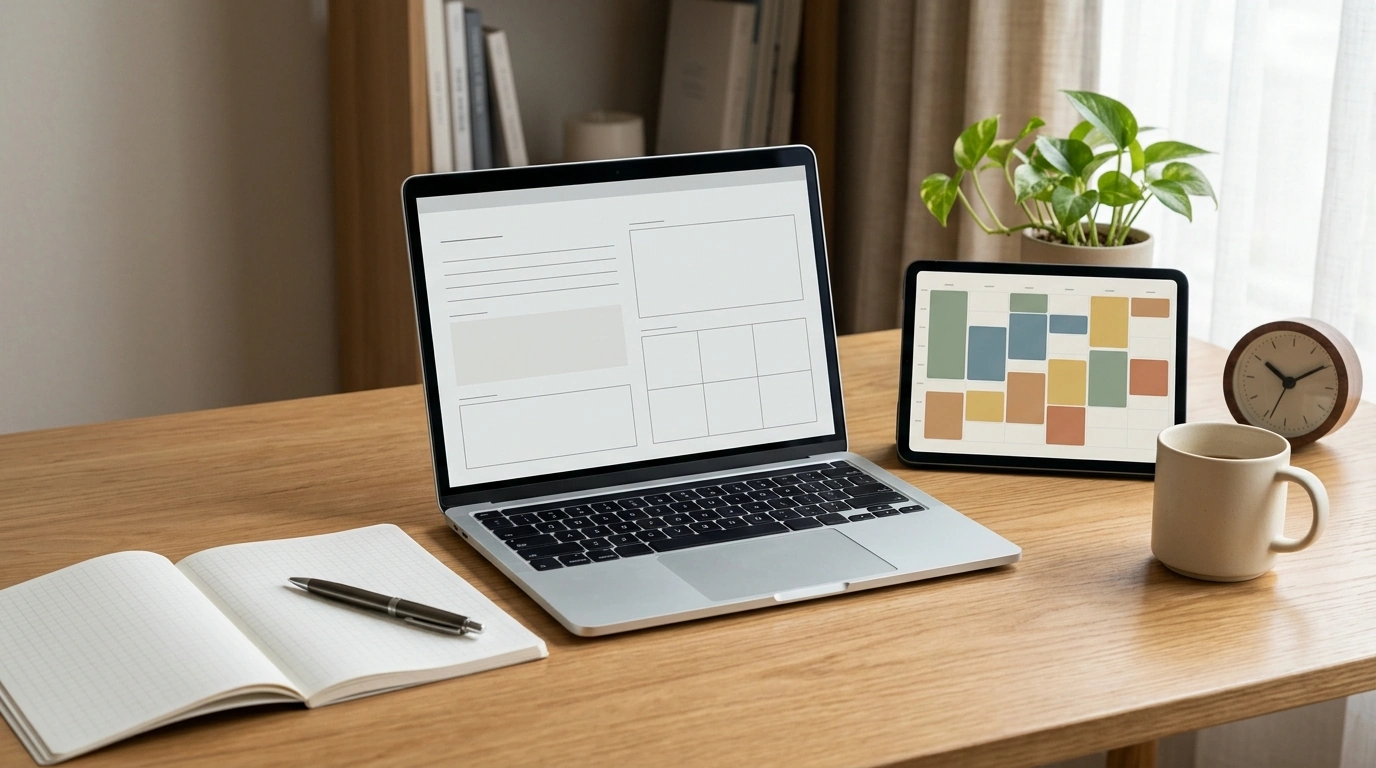
The Ultimate Productivity Blueprint: A Practical Digital Guide for Goals, Time, and Daily Routines
A sustainable productivity system balances clear goals, realistic time plans, and repeatable routines. This blueprint breaks productivity into a few simple building blocks—so priorities stay visible, days run with less friction, and progress is easier to measure week to week.
What a “blueprint” approach changes
Most productivity advice fails for one reason: it’s a pile of tips without a structure. A blueprint approach replaces randomness with a repeatable loop you can run every week—goals → plans → routines → review—so you always know what to do next.
- Replaces scattered tips with a repeatable system: goals → plans → routines → review
- Focuses on inputs you can control (time blocks, task limits, environment) instead of motivation alone
- Creates a single source of truth for priorities to reduce decision fatigue
- Builds consistency with small daily rules instead of occasional big overhauls
This is also more resilient under stress. When life gets busy, a system that relies on routines and clear next actions tends to hold up better than one that relies on “feeling motivated.” For a practical look at how time choices shape outcomes, Harvard Business Review’s time-management guidance is a helpful reference: https://hbr.org/topic/time-management.
Set goals that translate into actions
Start with outcomes that are small enough to finish and meaningful enough to matter. A good range is 1–3 outcomes for the next 8–12 weeks—long enough to build momentum, short enough to stay focused.
- Start with 1–3 outcomes for the next 8–12 weeks; keep them specific enough to track
- Define success metrics: what will be true when the goal is achieved (numbers, milestones, deliverables)
- Break each goal into projects (multi-step) and next actions (single-step) to remove ambiguity
- Use a weekly “Top 3” to protect the most important work from getting crowded out
Goal-to-Action Converter
| Goal outcome | Project milestone | Next action (15–30 minutes) | Success metric |
|---|---|---|---|
| Finish professional certificate | Complete Module 1 | Schedule two 30-minute study blocks | Module quizzes ≥ 80% |
| Improve fitness consistency | Establish weekday routine | Pack gym bag tonight | 3 workouts/week for 4 weeks |
| Launch a small side project | Publish first version | Outline landing page sections | 1 live page + 1 signup form |
If a goal feels overwhelming, it’s usually not because it’s “too hard”—it’s because the next action isn’t defined. The moment you can name a 15–30 minute step, the goal becomes operational instead of aspirational.
Time management that matches real life
Time management works best when it’s honest about constraints: meetings, energy dips, and surprise requests. The point isn’t to create a perfect schedule; it’s to protect your priorities inside an imperfect day.
A simple way to time-block without feeling trapped
Also pay attention to recovery. Chronic stress and poor sleep make planning harder to follow even when the plan is good; the APA’s overview on stress effects is a useful reminder of why pacing matters: https://www.apa.org/topics/stress/body.
Build daily routines that run on autopilot
Simple Daily Routine Template
| Routine moment | 3-step checklist | Time needed | Common obstacle | Quick fix |
|---|---|---|---|---|
| Start-up | Check calendar; pick Top 3; start first block | 10 min | Morning chaos | Prepare the night before |
| Mid-day reset | Scan tasks; re-block time; quick break | 8 min | Energy dip | Walk + water, then restart |
| Shutdown | Capture tasks; set first action; tidy desk | 12 min | Overtime creep | Hard stop + reminder alarm |
A weekly review that keeps goals on track
Tools and digital habits that reduce distractions
Optional “uniform” trick for fewer micro-decisions
If mornings feel scattered, reduce small choices. Some people find it easier to get into work mode with a simple, repeatable outfit—especially for study sessions, remote work, or creative blocks. A comfortable staple like the Nike Women’s Black Round Neck T-Shirt or the Nike Men’s White Cap with Print can act as a cue: put it on, start the first block, don’t negotiate with yourself.
Putting it together with The Ultimate Productivity Blueprint
A structured digital format helps keep goals, time blocks, and routines in one place. That’s where The Ultimate Productivity Blueprint fits: it’s designed for setting outcomes, mapping actions, building daily checklists, and running weekly reviews without juggling scattered notes.
Quick Start Plan (7 Days)
| Day | Focus | Small commitment | Result to look for |
|---|---|---|---|
| 1 | Choose priorities | Pick 1–3 outcomes for the next 8–12 weeks | Clear direction |
| 2 | Define actions | Write next actions for each outcome | Reduced overwhelm |
| 3 | Time block | Schedule two priority blocks | Protected focus time |
| 4 | Routine setup | Create a 10-minute start-up routine | Smoother starts |
| 5 | Distraction control | Turn off nonessential notifications | Fewer interruptions |
| 6 | Batching | Batch email/admin into one window | More deep work time |
| 7 | Weekly review | Review progress and plan next week | Consistency |
FAQ
How long does it take to build a consistent productivity routine?
Most people can build basic consistency in about 2–4 weeks if the routine stays small (5–15 minutes) and is reviewed weekly. Start with one routine moment (start-up or shutdown), then add the others after it feels automatic.
What’s the simplest way to prioritize tasks when everything feels urgent?
Choose a daily Top 3 tied to your current goals, schedule those first, and treat everything else as secondary until the Top 3 is protected. For the remaining tasks, do a quick urgency-versus-impact check to avoid spending the day on low-impact “fires.”
Should time blocking be strict or flexible?
Flexible works best for most real-life schedules: protect priority blocks, add buffer time, and move blocks when disruptions happen rather than abandoning the plan. The commitment is to the priorities, not to a perfect clock.












Leave a comment